Featured

Brass: Birmingham First Impressions

Occasionally, a board game comes along that is impossible to write about it first time around. Such is the case for Brass: Birmingham, a game that takes 3-4 hours to play, is split into two distinct phases, and has a theme revolving around the industrial revolution. It is, by all accounts of the term, really crunchy and is a puzzle right from the offset.

Today, we are going to take a look at that experience in a bit of detail and what it is like playing Brass: Birmingham. There is a lot to unpack with Brass: Birmingham, from the player interaction to the decks of cards. With that in mind, and rather than typing out around a 40 page rule book, here’s the let’s play video. If you don’t know Brass: Birmingham then it should be an interesting watch. If you have played Brass: Birmingham then it should also be an interesting watch – if only to refresh the rules –

Those two stages form the backbone of the game. Merchants around the edge of the board are randomised based on what they want. Where this is understandable, it is possible to have merchants who don’t sell anything, and this can cut off a segment of the board. This can also make the game frustrating at parts, adding to the challenge.

So, when we played this, yesterday (or yesterday at time of writing) I actually turned to the guy who owns the game and said “this reminds me of when you hear about secret handshakes – we’ve got to roll up our trouser leg, tap elbows, slap each other hands, chanted a poem, sing a song, and sacrifice a chicken to the dark lord Cthulhu…and then you can finally do what you want to do.”

Brass: Birmingham is a phenomenally complex game, and there are a lot of rules. As a game, when we played, it was the end of a games day (so we do have to keep that in mind), but it felt more complex, like there were more nuances in the rules, than games like TrickerionTwilight Imperium, or Tyrants of the Underdark. It is one of the most complex games we own in our gaming group, that is for certain.
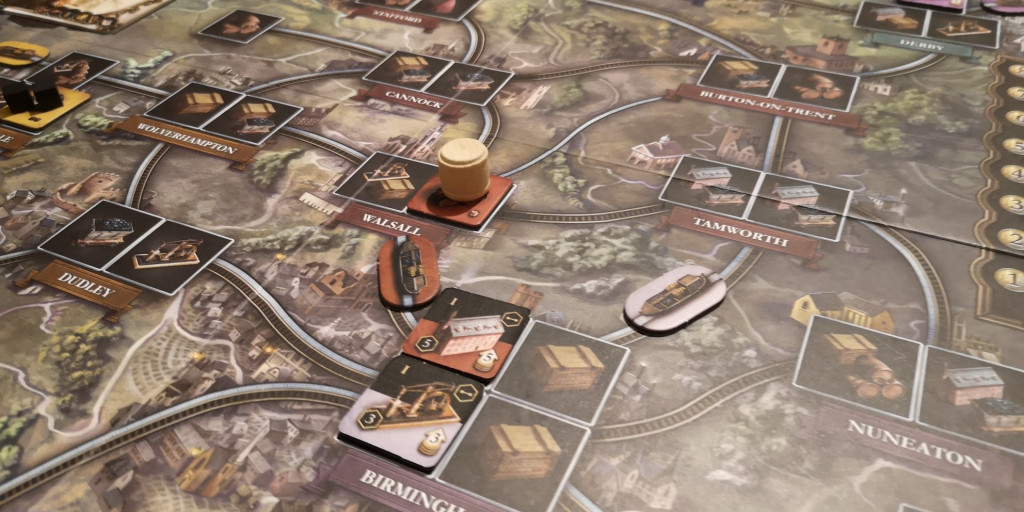
That being said, Brass: Birmingham has these brilliant moments. The first and second halves of the game are literally two different 8 round (with two players) games. The board almost fully resets, as all first level buildings and canals are removed. These then make way for railroads and…more buildings in the second part of the game. Any second level buildings (or higher) built in the first round stay in place.

So, what does this mean? Well, actually, and this only occurred during the second phase of the game, but Brass: Birmingham is actually a short term strategy game disguised as a long term strategy game. Where it is possible to over think and over analyse how to play the game, it is actually a game where long-term strategies don’t tend to come to fruition. This is due to the potential of other players using the resources you have generated during the game.

To put this into context, for the canal phase, I attempted a long term strategy, which earned me around 20 points in the first phase. Then, when the rail phase began, I actually ignored everything I had been doing and focused purely on short term gain. During that second phase, I scored around 95 points. That was a phenominal shift, and I think representative of the other players around the table as well. Brass: Birmingham turned from a “oh well, I’d better plan for 4 turns in the future” to “how can I get the maximum number of points this turn?”.

Once you get the hang of Brass: Brimingham it is actually remarkably simple. There are a few complex concepts, but once you get the hang of them, and once you understand that Brass: Birmingham is a short term strategy game with slight hints of long term then there is no reason it can’t be thoroughly enjoyed time and time again.

There are one or two things that need a shout out that really do make Brass: Birmingham something special, leaving aside the art work. Once understood, the economics system is superb. It creates a market place that thematically may be off at times, but generally speaking, the whole connections being placed between places concept works really well. It is route planning and route building at its finest. It is a bit odd how players don’t get paid for resources until all resources are gone, but we can overlook that for how beautifully the route building works.

Secondly, each location is a small puzzle. The idea that you get restricted on where you are placing or building based on your own network or location cards actually forces your hand as a player. Without that, I doubt it would be as difficult, and so that restriction is actually a welcome addition to the game. It makes the game something that really requires contemplation and optimisation.
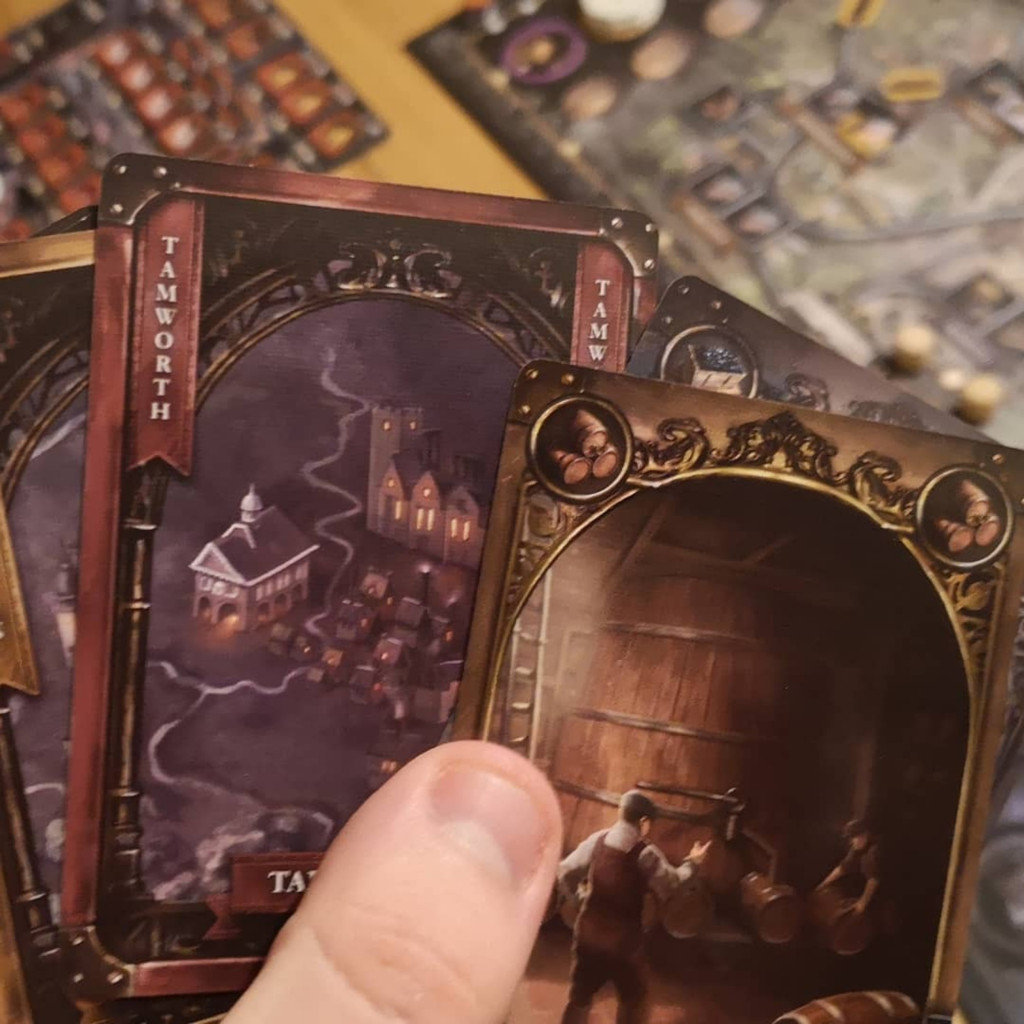
What I really like about Brass: Birmingham though, and ultimately why I am excited to play it again moving forward, is that it completely possible to get a small engine going. Brass: Birmingham is a game in which you can do two actions per turn, and it is possible to create a beautiful synergy between your turns based on a small engine once you get going. It can get to the point where the other players can’t get in your way, and boom, you are creating these great combos each turn. Those moments, those plays, are what makes games like Brass: Birmingham enjoyable.

I’ve been thinking a lot, whilst writing this, about how best to end it. Well, what I can say is that Brass: Birmingham is not a perfect game. There are slight holes in the theme, and there are slight quirks that can throw a game off; however, and this is a huge however, it is a very very good game. Generally speaking, for the first hour and a half, for the entire canal era, I didn’t have a clue what I was doing and that did impact the fun. That being said, I recognise that knowledge was an issue and as such, yeah, I can’t wait to play again.

What do you think? Obviously, there is a lot that can be said about a game like Brass: Birmingham, and we have literally just scratched the surface today, but those were my first impressions. What were yours? Let me know in the comments below.
Betrayal at House on the Hill Review – Traitors and Omens

There are certain games that are just difficult to review. Whether it is due to specific components, or the size of the game, the theme, or specifically one or two mechanics, there are certain games that just slip through the net as hard games to talk about. Today’s game, this one right here, is one of those games. That game is Betrayal at House on the Hill.

Betrayal at House on the Hill is a game we have a bit of a history with. It was, as board gamers, the first big box game we ever bought. Released in 2004, it has now been around for almost 16 years. It was designed, amongst other names, by Rob Daviau, the mind that later graced the world with the smash hits Pandemic Legacy: Season 1 and Season 2. He is also the designer who came up with Seafall, a statement that I will leave there.

Betrayal at House on the Hill is a game that I have actually talked about with Wil Wheaton himself, at Destination Star Trek. It is a game my partner and I have absolutely loved as a couple, and then…since then…everyone else we have introduced it to has either mildly enjoyed it or hated it more than life itself. We have one friend who ranks it in his worst ever games, meanwhile we still have a special place for it in our hearts.

Today, we’re going to break that down a little bit – what is it that makes Betrayal at House on the Hill interesting? What is it that makes it so inconsistent? What is it that makes Betrayal at House on the Hill what it is?

Betrayal at House on the Hill is a 3-6 player, horror based, exploration game designed by Rob Daviau and published by Avalon Hill. It is advertised on the Avalon Hill website as taking an hour to play. In reality, it easily takes 2 hours.

Betrayal at House on the Hill, which is regularly shortened to simply “Betrayal”, is a game in which players first of all work collaboratively to explore a haunted manor, before the game switches half-way through. Halfway through, the game changes and one player becomes a traitor. The survivors and the traitor then get separate halves to a new story, or plot. From that moment on, the game shifts. It is now a game of the traitor vs the survivors, and only one side can win

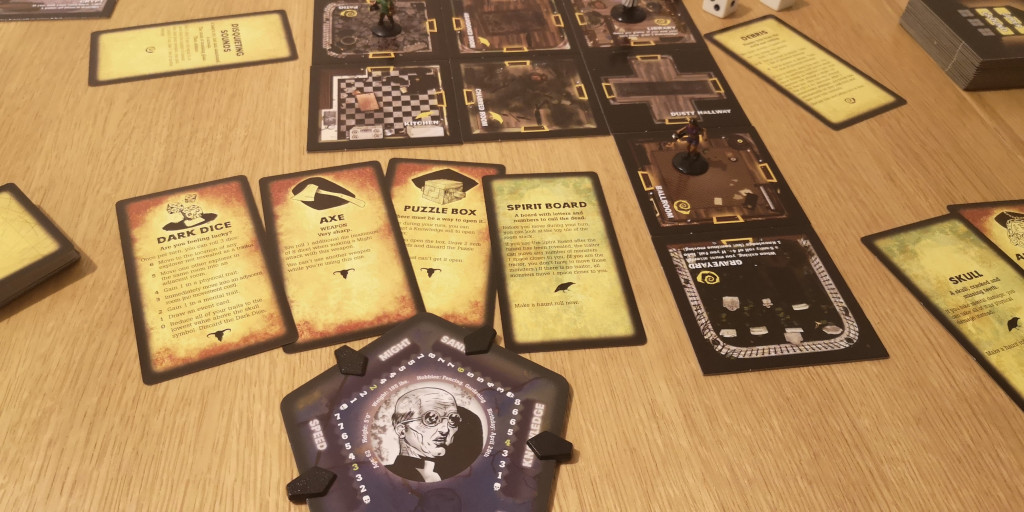
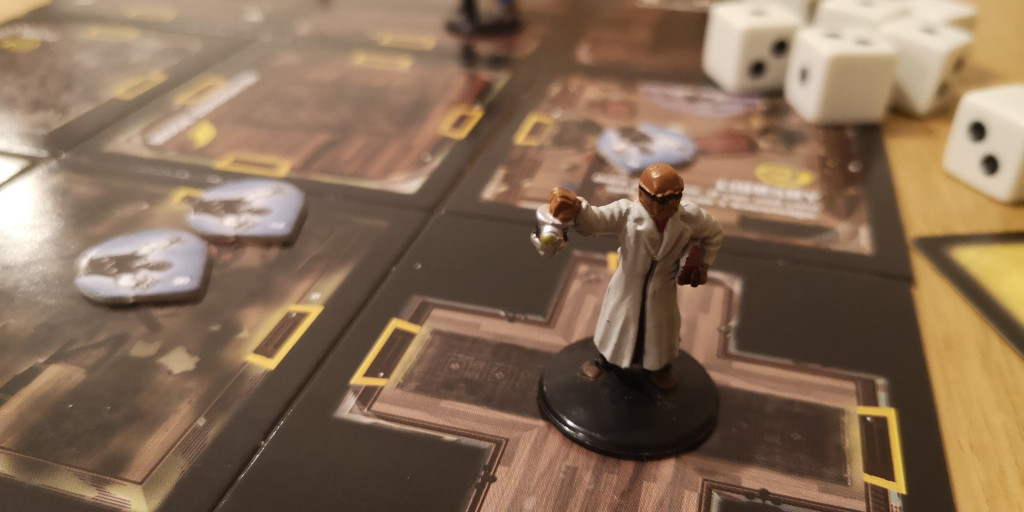
Explaining how to play Betrayal at House on the Hill is not an easy task. The first half of the game is always the same. Players each choose a character, one of two options of up to six miniatures. That character represents that player, and with four stats apiece representing Speed, Might, Knowledge and Sanity.

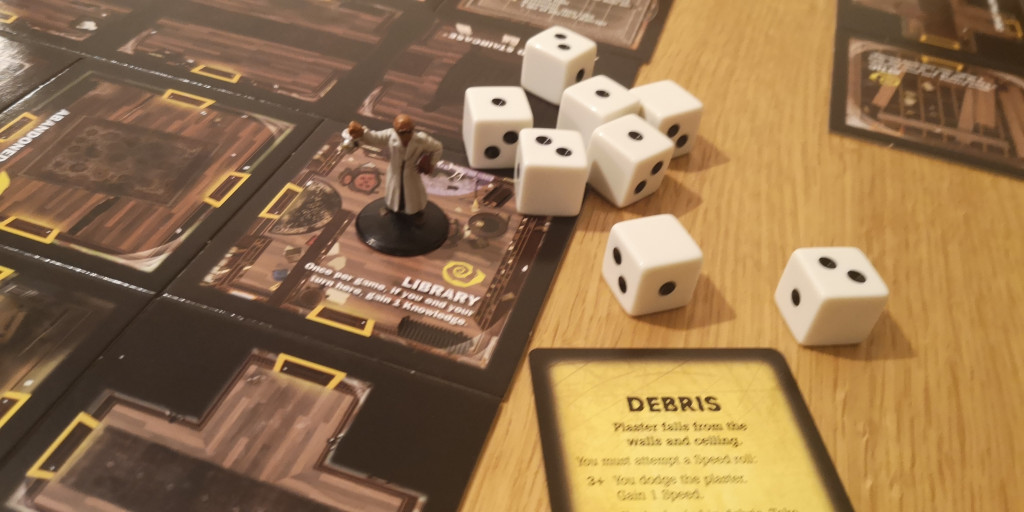
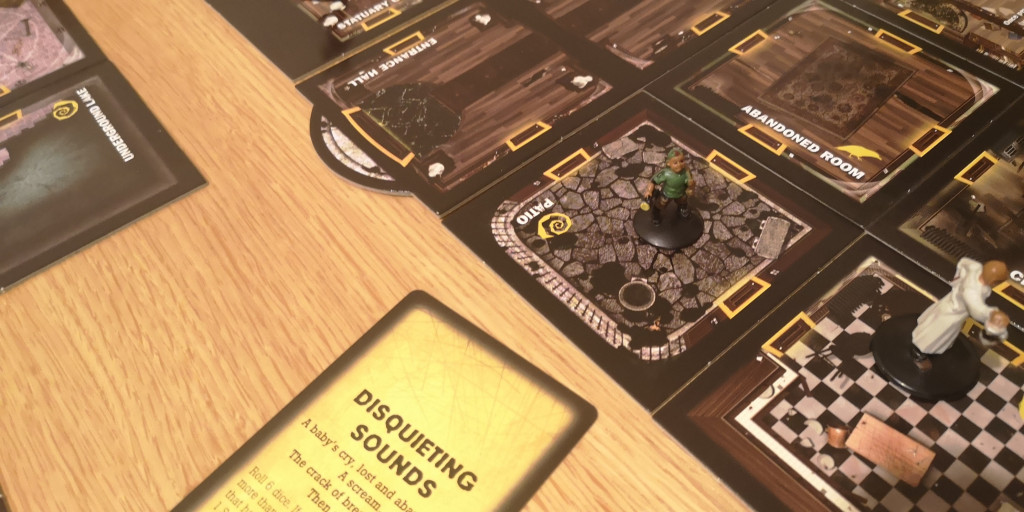
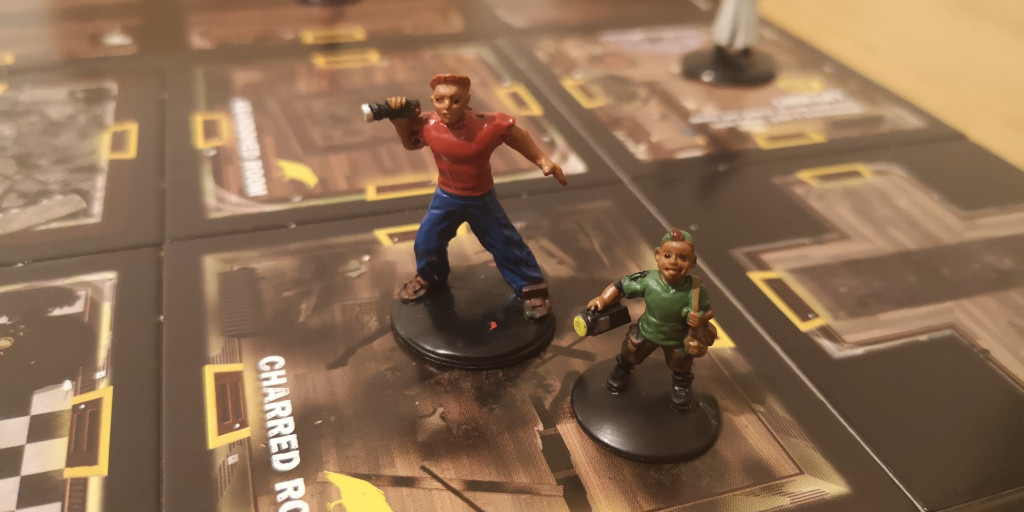
As players you all start off in the main hallways of the manor, a haunted mansion of magnificent proportions. You, as the players, take it in turns to explore the rooms, moving and uncovering tiles from a stack when you get to a door. Once you open a door the player can come across either a normal room, with nothing special (in which case they keep moving) or rooms with Events, Items, or Omens. These add flavour to the game, kitting players out and adding special occurrences to make everything feel incredibly active and relevant. Sometimes the rooms add on an additional specific effect, adding a bit of a risk and a gamble to exploring the house.

Events are the life blood of Betrayal, adding in specific moments of horror. Omens, however, are a core mechanic in the game. Every time an Omen is uncovered or explored, dice are rolled. That test, the roll of the dice, is pivotal to the game of Betrayal, as it gets harder with each and every new Omen. If that roll is failed, the HAUNT begins.

The Haunt tends to mark the midway point in a game of Betrayal at House on the Hill, and it is also the reason explaining the rules is so hard. Essentially, when the haunt happens, depending on the omen that triggered the Haunt and the room that omen was found in, there is a whole reference table of options, showing what the haunt could be.

There are 50 options at that point as to where the game could go. The Haunt will then specify who the traitor is (usually, but not always, the person who found the Omen) and the real game begins.

At that point the Traitor and the Survivors are split into two groups. The Traitor takes the Traitor’s Tome, whilst the Survivors have the Survivors’ Handbook. They each turn to the number of the haunt and now there are new rules to the game. The Traitor has their victory conditions whilst the Survivor has theirs.

This is where things can get weird. The Traitor has their own conditions – however, they may not be alone. They may be with a monster or pack of dogs. They may have evil on their side, or they may be trying to raise creatures from the dead. Anything can happen, and each time the rules are different.

At the end of the game, one of the two sides will have won – either the Traitor or the Survivors.

It is very rare that a board game review can sum up what a game is like to play with just one word, however, that is the case with Betrayal at House on the HillBetrayal is, rather unfortunately, an incredibly inconsistent game. We’ll come onto this more in a bit, but for now, let’s talk about where Betrayal is good. This is because, when Betrayal is good, it really is great.

There are very few games that can instil a sense of dread well. The horror genre is hard to do justice to via the board game medium, namely because the atmosphere is rarely at the level it needs to be for effective horror.

This is one place where Betrayal at House on the Hill is incredibly strong, not because it instils a sense of dread once the haunt has begun, but rather it instils that sense of dread whenever an Omen gets revealed. Every time the little crow icon, denoting an Omen is uncovered, there is this fantastic moment when all the players hold their breaths. Will this be the moment? Will this be when the Haunt begins?

Ironically, the real dread in Betrayal at House on the Hill doesn’t come from the horror, but rather it comes from the anticipation of horror. It comes from the anticipation of the haunt, and there is something truly magical about that.

At its best, the exploration is exciting and new. At its best, the characters feel like extensions of your own playing ability. At its best the haunts are thrilling and amazing and have you sat on the edge of your seat for the entire game. Will you win? Will the traitor? Will the survivors? Who knows!?!

Betrayal at House on the Hill is one of those games that can glow, and that is one of those things that can’t be said very often about any game. It is a game that truly shows that board games can be something different other than Monopoly or Scrabble or Cluedo. It is a game that proves that something different can happen almost every time you play. It is a game that shows that board games can evolve and adapt. It is a game that is phenomenally exciting to discover as a new player – LOOK AT IT AND LOOK AT ALL THE POSIBILITIES!!!

That is Betrayal at House on the Hill at its best, and it will be its best a good 1/3 of the time. One in every three games will be amazing and new and fantastic and brilliant.

But then there will be the other 2/3 of the time. We’ve played Betrayal at House on the Hill more times than I can count, most of which were around 4 years ago. We’ve has some amazing nights exploring the mansion, and discovering new things. Then we’ve had nights where everything has been…well…okay. Everything has been fine. In fact, I would say, 1/3 of the time things have been generally…okay.

Now there is nothing wrong with a game occasionally giving an okay experience. You may be in a different mood as a player, or the roll of the dice may mean something happens too early or too late. Rooms or events may come up that may penalise you, and the haunt may not be quite what it was the game before. That is generally okay as a one off; however, Betrayal is oddly consistent with its inconsistency. Around 1/3 of the time things will be fine, and when things are only okay one third of the time you do start to question – do those times when the game is amazing make up for it?

Finally, there is the other 1/3 of the time when the game just isn’t enjoyable. The rolls are horrible, the tiles/rooms come out in the wrong order, the players just don’t get into it. Those are all things that are forgivable in their own right; however, when the plot is unenjoyable, when the haunt is not fun, that is where the issue lies.

There is a problem with Betrayal at House on the Hill where the haunts are relatively inconsistent (there is that word again). Sometimes they will be wonderous and fantastical. Other times, the will feel dry and be a real push. They can turn into a slog. You can now probably see why this game is so hard to write about from a review perspective.

Okay, so, is Betrayal at House on the Hill a good game? This is something I actually tried to rationalise mathematically a year or two ago (on this very blog, I believe). I probably failed back then, so let me answer from a review perspective instead. Yes and no.

Personally, I believe that if you are a player of RPG games or like games with a lot of exploration then yes – give Betrayal at House on the Hill a go. Even if you are a D&D fan, try Betrayal at House on the Hill before you try Betrayal at Baldur’s Gate. It is, in my opinion, a better game. Betrayal at House on the Hill was made for RPG fans, and it placed players in a more confined space that really truly pushes them to their limits in regards to exploration and, in some cases, teamwork.

If you are a player who enjoys the one-against-many traitor style mechanic, then YES, give Betrayal at House on the Hill a go. The whole game will pay off big time, almost every time you play. It uses the traitor mechanic well.

If, however, you are the kind of player who prefers more consistency and more structure to your games then maybe give Betrayal a skip. If money is an aspect, then spend your money on something more consistent. If you just don’t like roleplaying games, then don’t play Betrayal at House on the Hill. Go for something more robust like Dead of Winter. You’ll probably get more out of it.

This has not been an easy review to write. Betrayal at House on the Hill is a difficult game to talk about and even make sense of because there is so much there to try to unpack. Should you buy it? Well, the simple truth is – I don’t know. So, with that in mind, let me end with a bit of an explanation of the first time we introduced it to our regular gaming group.

Myself and my partner had be playing Betrayal at House on the Hill for around six months before we introduced it to our regular gaming group. Until that moment we had introduced it to small groups of family and friends, and we had, generally speaking, had great fun.

So, we were really happy when we brought Betrayal at House on the Hill to the table. We were ecstatic in fact. We unpacked the box, and we started the game with 5 players. Everything went incredibly well during the exploration, right up until the Haunt.

Then a rubbish haunt came out. It was horrible and broken and frustrating. I don’t remember what the haunt was, but there was anguish around the table. That was over 4 years ago, and to this day our gaming group refuse to replay it. It was suggested that, if I want to bring it to the table again, I actually filter through the haunts to see which ones are best so we can play those. I don’t know. It just wasn’t good.

So, if this a game that has you and your regular gaming buddies excited then YES, buy it. It is a box of amazing fun; however, if only you are the excited one, then this may just be a box of heartache.

Wow, what a melodramatic note to leave on, but we will leave it there. Betrayal is a game that still holds a very special place in my heart, and if myself and my partner can find a third player to play it with then I am sure we will have an amazing time again.

So, on that, what are your thoughts? Do you enjoy Betrayal or would you rather stay away? Let me know in the comments below.
Celestia Review – Exploring Cloud Nine

Celestia is an interesting game. So many reviews start that way, but Celestia really is something kind of unique. As a game it is, generally speaking, very well reviewed by the blogging and vlogging community. It then, for some reason, became incredibly cheap in the UK for a short period of time. At which point, it entered our gaming group.

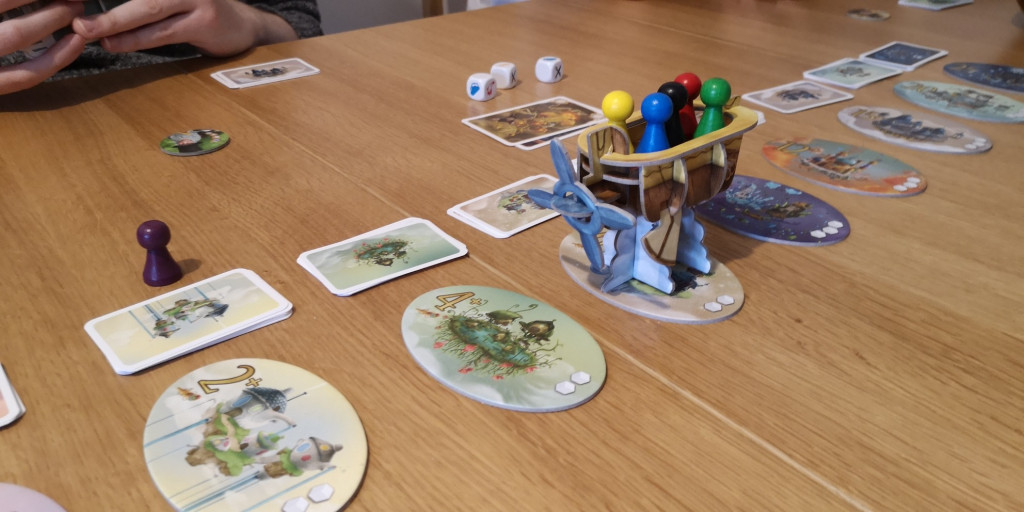
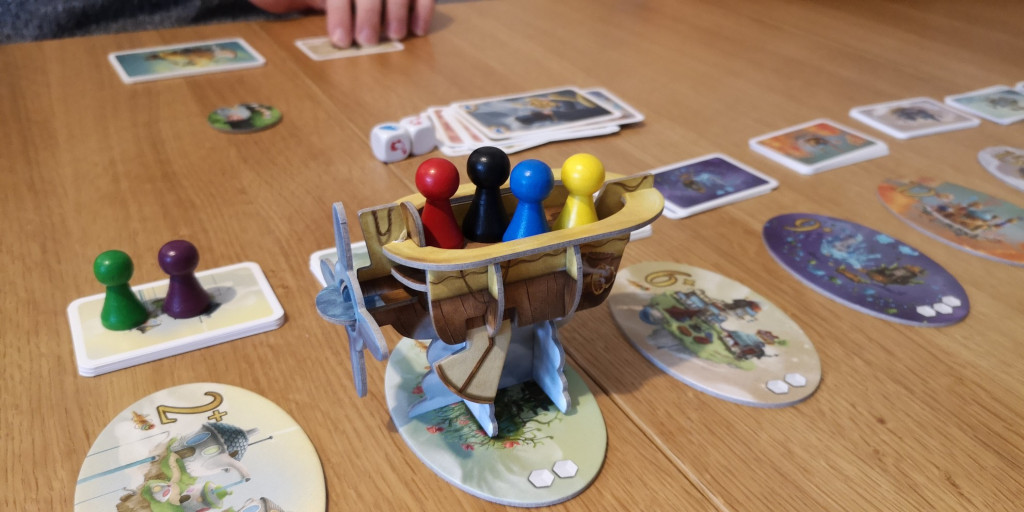
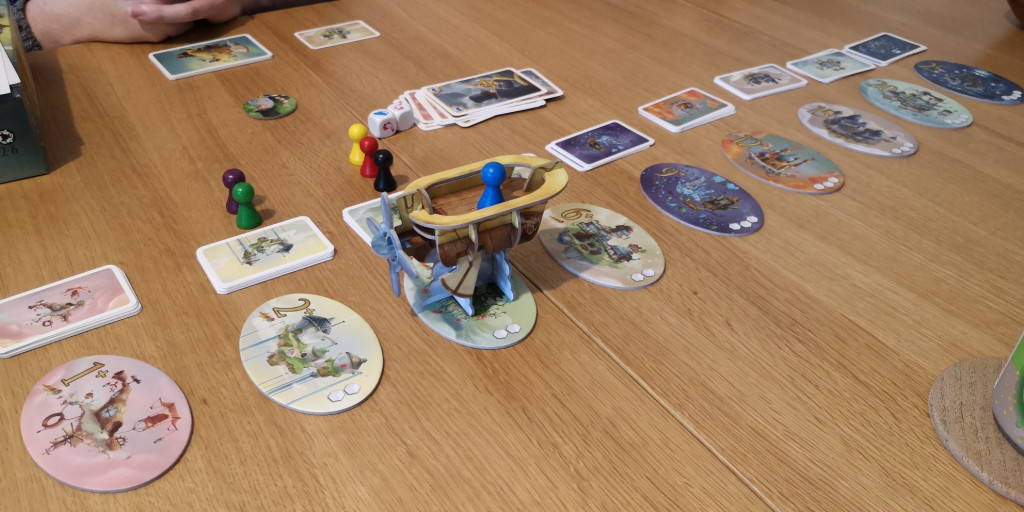
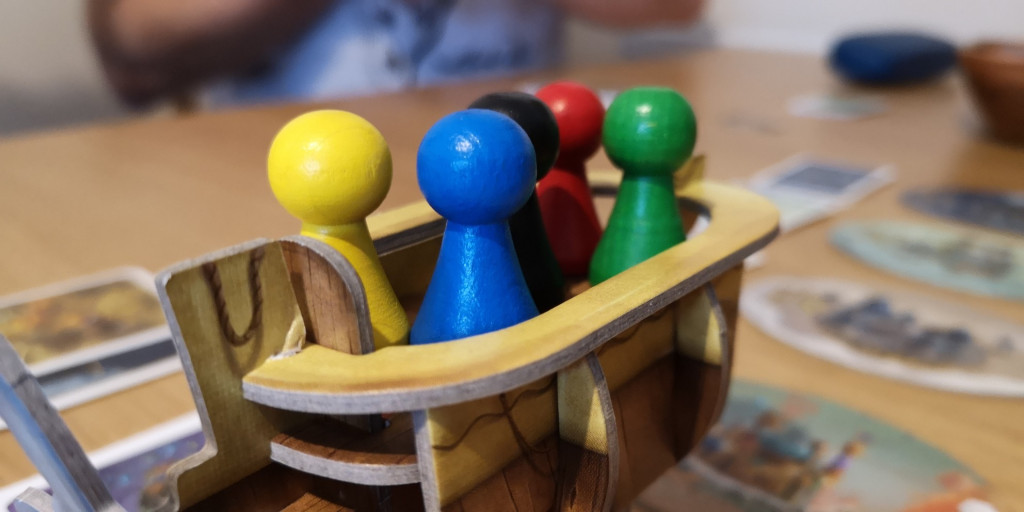
Celestia is ultimately a push-your-luck game that has a bit more to it. What is more, it features a little airship that you move around – so, you know….that’s awesome. Today we’re going to take a quick look at Celestia and what makes it slightly different in this review.

Celestia is a fairly simple game, with an interesting premise, designed by Aaron Weissblum and with art by Gaetan Noir. It is a game for 2-6 players, although the higher the player count generally the better it is. Celestia takes around 30 minutes to play.

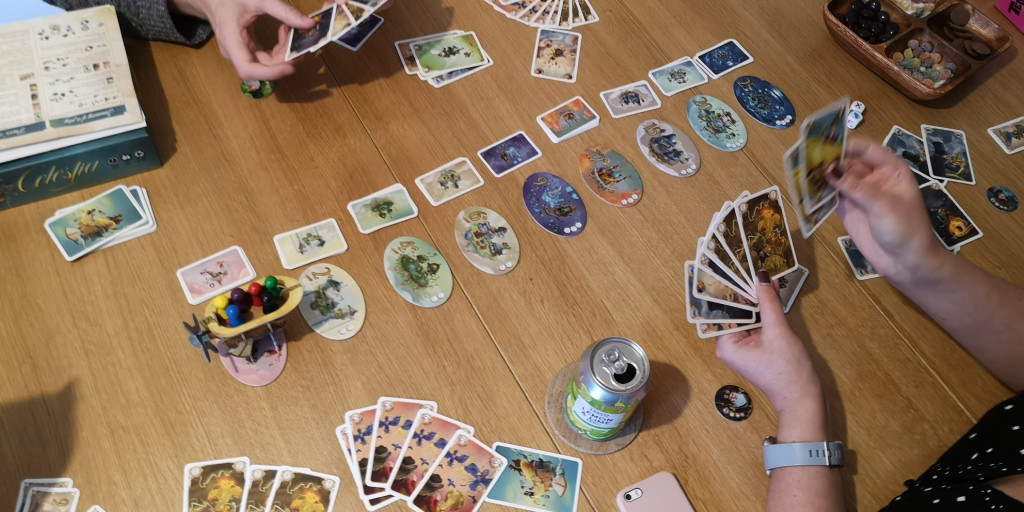
Celestia sees players take it in turns captaining an airship between floating cities. At any point, players can bail from the airship and explore each city, gaining treasure. In between the cities, however, the captains face challenges that they must pass to progress onto the next island and next point of relative safety. At each progressive island the loot gets better and better.

If the captain fails, the ship goes down and the game is reset. Players take their loot from the cities, and the moment a player reaches a loot value of 50, the game ends.

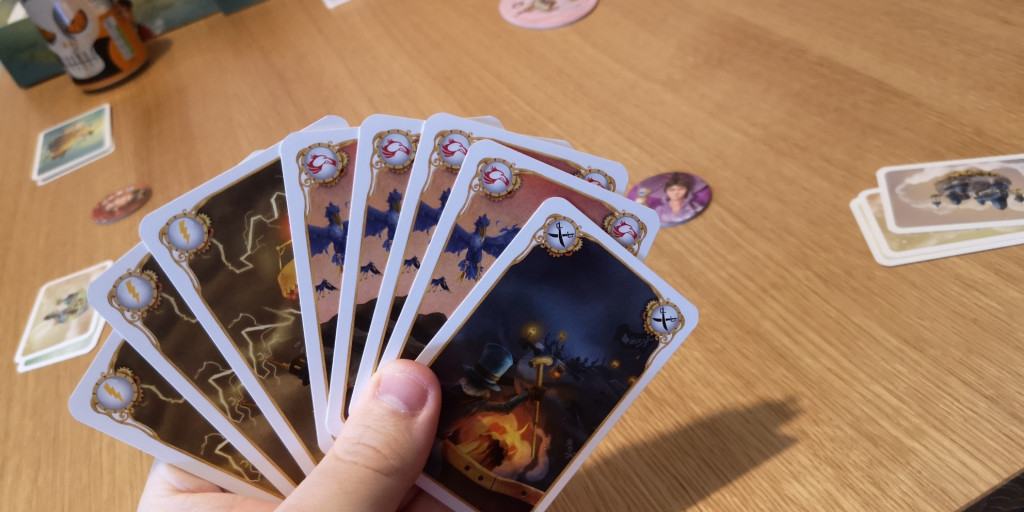
So, that is a brief overview about how to play but what about the nitty gritty? Well, Celestia is a dice rolling and hand-management (sort-of) kind of game. Each player is given a hand of 6 cards, each depicting a type of one of four challenges. Those may be a lightning storm, a pirate invasion, clouds, or a flock of birds.

Okay, so picture this. You are on an city. It is your turn to be the captain. You are on the “2” city and looking to progress to the “4” city. What you do is you roll two dice, as depicted on the side of the city tile. You roll a flock of birds and a lightning storm. Now, this is where it gets interesting.

It is up to players to decide if they believe you have the cards it takes in your hand to surpass the obstacles. Do you have a flock of birds card and a lightning storm card? Our friend believes you do, so he/she stays on the ship. I don’t believe you do, so I decide to bail. As such, I get out of the airship and stand on he floating city.

It turns out you did have the cards, and so you progress. You discard those cards, but you don’t draw back up. This immediately creates a new dynamic as you now don’t have many card for your next roll.

As you progress the challenges get harder, and at certain cities the amount of dice you need to roll increases. The captain rotates every single city in Celestia, so a new player is always in charge, and eventually, the airship will crash, and players reap the rewards of the cities they were on assuming they got out before it crashed.

At the end of the round, everything resets. The airship goes back to the start, loot is claimed, and everyone gets one (and only one) card.

Most of these cards help you defeat obstacles; however, a few are special cards that can allow for rerolls, force rerolls, or even allow you to see if the captain has succeeded in the challenge before abandoning ship.

So, rather nicely, that is basically it. To simplify, the rules refers to that whole process in simple steps (which I paraphrase below):

  1. The captain rolls dice to determine the challenge (or determine what they need to overcome)
  2. Each other player chooses to stay on the airship or get off (the captain must stay).
  3. The captain plays cards or loses.
  4. If the captain passed the challenge they move the airship. If they don’t, they crash out – skip straight to point 6.
  5. The captain passes control of the airship to the next player – go back to point 1.
  6. If the ship crashes, those still aboard get nothing. Those who got out at islands, get loot from that island. Everyone draws a card.

So, what is Celestia like to play?

Okay, so now we break it down into more opinion. We’ve already explored how it is played, but what it is like to play, well, that is something different. I have to admit that, when my mate first said “I have this game called Celestia” and he explained the concept to me, I wasn’t hugely engaged. The airship is a gimmick, and gimmicky games tend to be quite hit-and-miss. The concept seemed a bit fluffy. All it all it didn’t grab me.

I was, I have to admit, partially wrong. Celestia is a fun game, and it is a push-your-luck style game that has a little bit more to it. The core game play is highly random, from the cards that you have to the dice rolls. That part of the game is almost autonomous as bar a few cards that allow for rerolls there is very little you can do as captain. If you have the cards, you have to play them. If you don’t have the cards then you crash; however, if anyone who looks at Celestia and pegs it for a simple push-your-luck style game then they are seriously doing it a disservice.

You see, Celestia has a bit more to it in regards to strategy and with meta-gaming as well. Being the captain isn’t really what the game is about, but instead it is about being strategic in how you play as a passenger. There is this beautiful moment that happens with in Celestia where it dawns on you and things start slotting into place.

The captain has just rolled the fourth flock of birds in a row, and you know your hand has five bird cards, so can they physically make it? You find yourself trying to card count and figure out how many cards there can be out at any one time compared to the size of the pile.

Likewise, you know your own hand and you see that when it comes around to you you’ll only be able to handle a flock of birds and a lightning storm – that means there is a 22/36 chance of you not being able to succeed on your next turn. Since as captain, you can’t bail, should you bail now?

And it is those kind of conflicts that makes Celestia really quite novel and fun. It is a game that makes the most of what it has and gives it all.

All in all, Celestia is a game that allows for great atmosphere. Everyone kind of bonds over those moments of determining if the airship has crashed or not. Even more fun is when it does crash and everyone lets out their exasperated cries as players, cursing the captain even though it is pure luck. It is a fun and funny game.

Plus the airship is kind of neat – so there is that as well.

All-in-all though I am really glad that Celestia got bought into our gaming group. It is a fun little filler game that doesn’t require a huge amount of thought. It can be played as a sorbet game, and thus is really good for little breaks in between two larger games. We actually cushioned it between Between Two Cities and Istanbul. It was a good laugh.

Design a site like this with WordPress.com
Get started